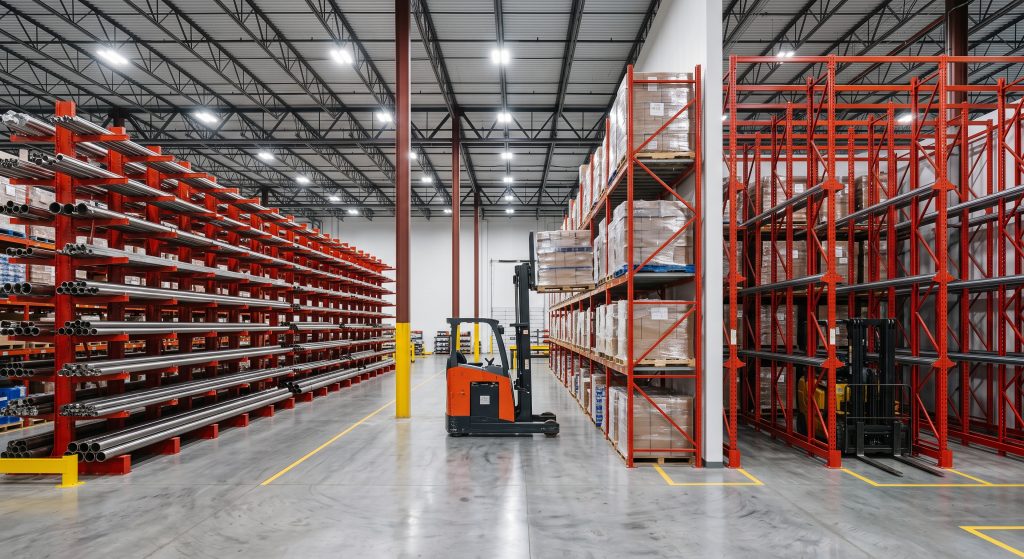
These three systems get compared constantly because on paper they all do the same job, hold inventory off the floor, but they’re built around completely different assumptions about what you’re storing and how you access it.
Pallet racking: the default for a reason
Standard pallet racking (our Iron Fist range) gives you direct access to every single pallet position. That matters if you’re running many different SKUs and need to pick any one of them at any time, following a first-in-first-out flow. It’s the most flexible of the three, and the easiest to reconfigure as your inventory changes.
Drive-in: density over access
Drive-in racking sacrifices individual pallet access for raw storage density, a forklift drives directly into the rack structure along rails, stacking pallets several deep. It only makes sense when you’re storing large quantities of the same product, because the system works last-in-first-out per lane: the last pallet loaded into an aisle is the first one out. Try to run high-SKU-variety inventory through drive-in racking and you’ll spend more time shuffling pallets than picking them.
Cantilever: when length is the problem
Neither pallet racking nor drive-in racking can hold something 4 metres long, there’s nowhere for it to rest. Cantilever racking solves this with arms projecting from a central column instead of enclosed shelf levels, so length becomes a non-issue. Our Séquoia range is built around a patented forged connector between arm and column specifically to keep that arm rigid under long, heavy, awkward loads, timber, pipe, steel profiles, anything that doesn’t come in a neat rectangular box.
The quick version
Need fast access to many different SKUs? Pallet racking. Storing a large volume of a small number of SKUs and want maximum density? Drive-in. Storing anything long, irregular, or oversized? Cantilever. Most warehouses actually end up running a mix of all three across different zones, which is exactly why we distribute all of them under one roof.