
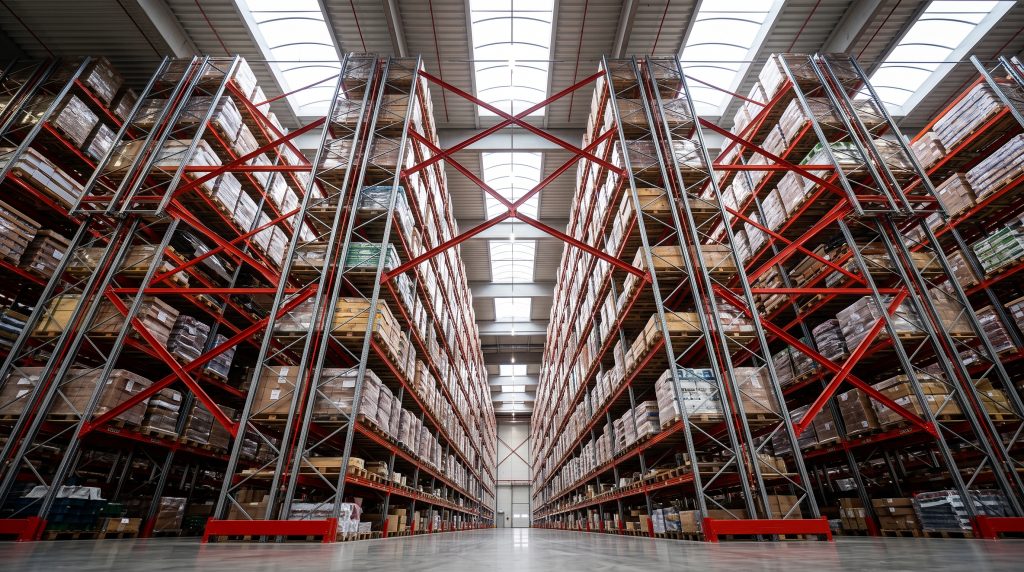
Racking failure during an earthquake isn’t primarily about the steel snapping, it’s about the whole structure swaying, twisting, and eventually toppling because it was never engineered to handle horizontal, dynamic forces in the first place. Most racking is designed only for static vertical load.
Why tall pallet racking is a special seismic risk
The taller and narrower a racking structure is relative to its base, the more it behaves like an inverted pendulum under lateral ground movement, exactly the geometry of a fully loaded, multi-level pallet racking row. Add loaded pallets at height, and a structure that easily handles straight-down weight can become unstable the moment that weight starts moving sideways.
What seismic-rated racking actually does differently
Seismic design standards like UNI EN 16681 (Static steel storage systems: Adjustable pallet racking systems: Principles for seismic design) specify how a racking system’s connections, bracing, and base fixings need to behave under lateral, dynamic loading rather than just static weight. It’s a fundamentally different engineering problem from everyday load-capacity design.
Where Rackit’s racking already stands on this
The Iron Fist pallet racking range is designed against EN 16681, the European standard for the seismic design of steel pallet racking, rather than retrofitted to meet it. That’s on top of the Iron Fist no-sliding static beam design, built specifically to resist shocks and keep stored goods from shifting during sudden movement.
What to ask before installing tall racking
If you’re installing racking above two or three levels, ask directly whether the system has been engineered and tested against a seismic design standard, not just rated for static load. It’s a question most suppliers won’t raise unprompted, because most racking on the market simply hasn’t been tested for it.
See the full certificate on our Certifications page, or explore Iron Fist directly.