
Before you ask for a quote, you can already estimate how many pallet positions you need and what load each level must carry. This is a planning guide; final dimensions and ratings always come from the supplier’s calculation.
Step 1: count what you really store
List your pallets by type: footprint (for example 1200 × 800 mm Euro pallets), height and weight. Use your heaviest regular pallet, not the average, for the load rating.
Step 2: decide how many positions you need
Take your peak stock, not the average. Then add a margin for growth and for the fact that racks are never 100% full, a figure around 10–15% spare is a common rule of thumb.
Step 3: find the positions per bay
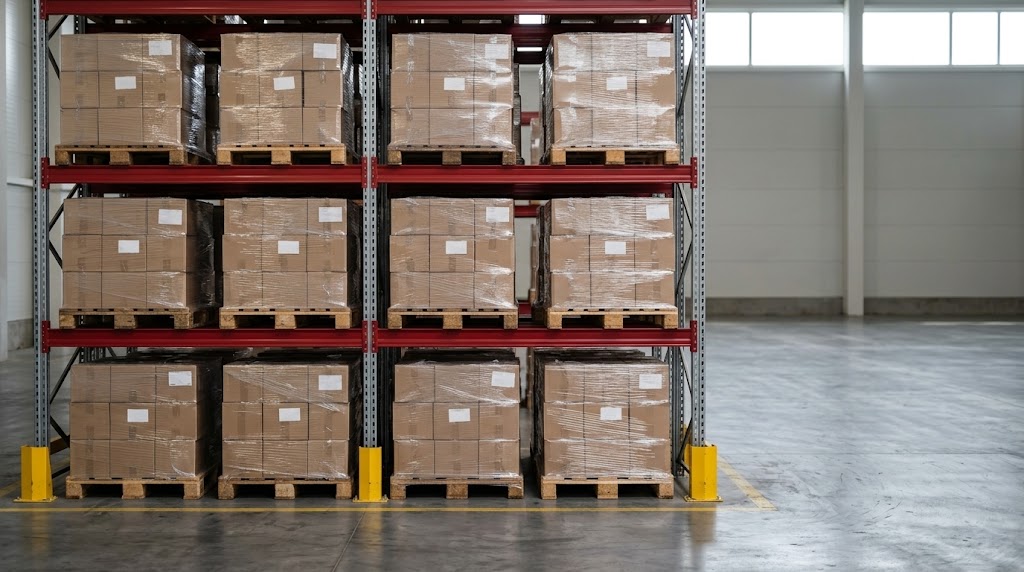
With standard pallet racking, a bay commonly holds two or three pallets per level, depending on beam length. Multiply by the number of levels. For example, a bay with three Euro pallets per level and four levels holds twelve positions.
Step 4: check your building
Usable height decides the number of levels: leave clearance above each pallet for the forklift to place it, and keep the required distance below sprinklers and lighting. See our aisle width guide for the floor side of the calculation.
Step 5: set the load per level
The load per beam level is the number of pallets on it times the weight of your heaviest pallet. Ask for racking rated above this value, and make sure a load plate is fixed to every bay. Our Iron Fist pallet racking is designed for this kind of use.
Does the floor matter?
Yes. The concrete slab must carry the point loads under each upright, so the supplier will ask for its thickness and quality.
What if my pallets vary a lot in size?
Design for the largest regular size, or mix pallet racking with other solutions for oversized goods, such as cantilever racking.
Need help choosing or planning your racking? Request a free quote and our technical team will help you plan it.