
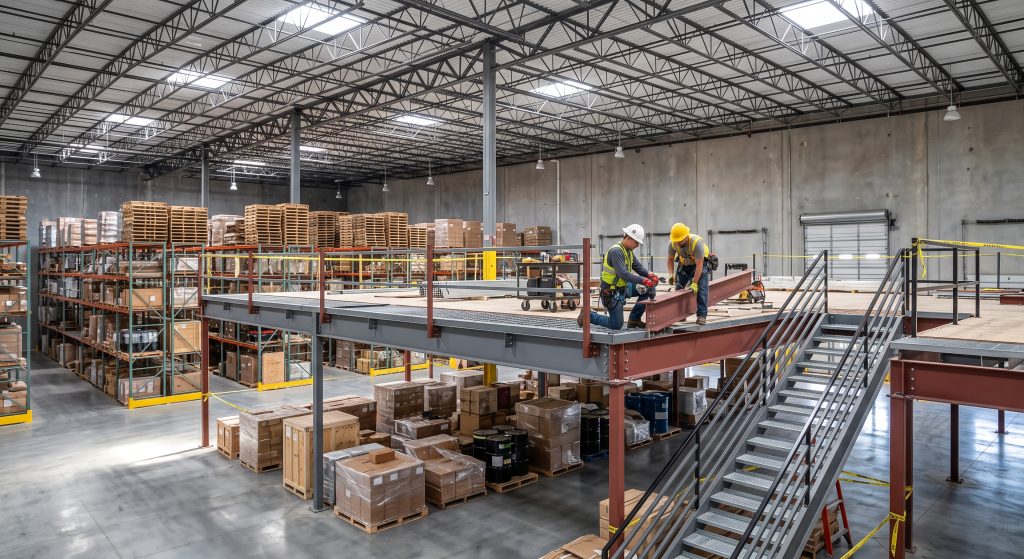
An industrial mezzanine is one of the fastest ways to add usable floor space without moving to a bigger building, but “fast to install” doesn’t always mean “license-free,” and getting this wrong can mean expensive rework later.
The rule that actually matters: does it increase constructed area?
Portugal’s legal framework for construction, the RJUE (Regime Jurídico da Urbanização e Edificação, under Decree-Law 555/99), requires prior municipal authorization whenever a project increases a building’s total constructed area, new floors, rooms, or annexes included. A mezzanine, by definition, adds a usable intermediate level inside an existing building, and when that pushes the constructed area up, it falls under this requirement.
Why this catches people off guard
Because a mezzanine is built entirely inside an existing warehouse shell, no new foundation, no change to the building’s outer envelope, it’s easy to assume it’s exempt from licensing. Whether that’s true depends on how the local Câmara Municipal classifies the specific project, which varies by municipality and by the mezzanine’s exact scope (a small technical platform versus a full second floor used for storage and operations are treated differently).
What we’d recommend before you commit
Check with your local Câmara Municipal early, before finalizing a design, not after your mezzanine is already fabricated. This is also exactly where working with an experienced installer helps: our technical team plans every Mecano mezzanine project with the layout, load path, and structural details a municipal review will actually ask about, so there are no surprises mid-project.
Thinking about adding a mezzanine level to your warehouse? See how Mecano works, or talk to us about your specific space before you start the paperwork.