
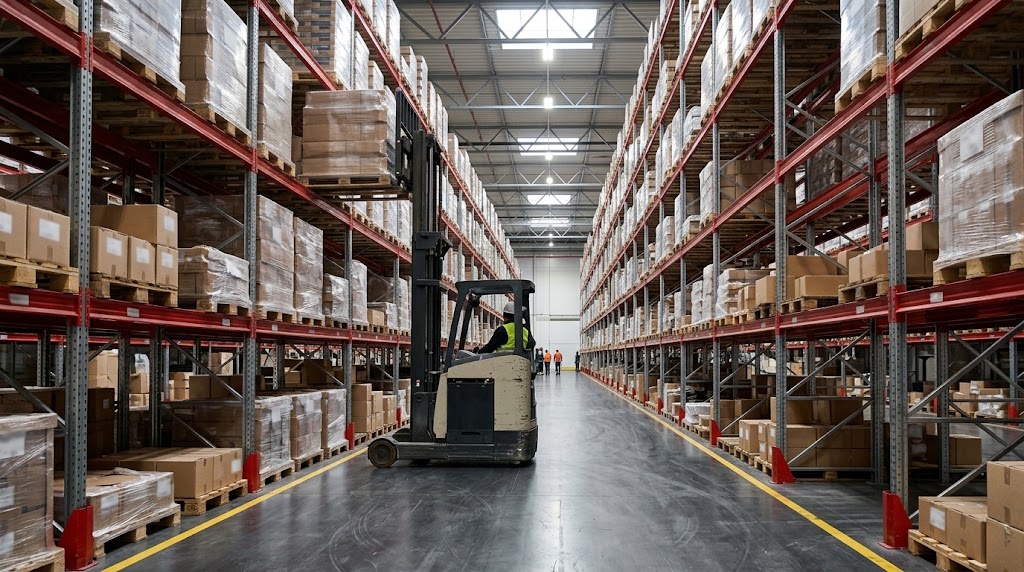
Aisle width is a trade-off: wider aisles make handling easier, narrower aisles give you more pallet positions. The right choice depends on your truck, so always start from its datasheet.
Counterbalance forklift
The most common truck and the easiest to use. It needs the widest aisles, typically in the region of 3.5 to 4 metres for pallet handling. It suits mixed operations and doubles as a loading-dock truck.
Reach truck
A reach truck extends its forks into the rack, so it needs a narrower aisle, often around 2.7 to 3 metres, and lifts higher. It is the usual choice when you want more density and height in a standard warehouse.
Narrow-aisle (VNA) trucks
Very-narrow-aisle trucks work in aisles of roughly 1.6 to 2 metres and reach the greatest heights, but they usually need a guided or wire-guided floor and a flat, high-quality slab. They give the highest density and the highest cost.
Do not forget the rest of the floor
Allow space for cross-aisles, fire exits, doors and the loading zone. Aisle width also affects how many pallet positions you get per square metre, see how to calculate pallet positions.
How the racking fits in
All of these work with standard pallet racking such as Iron Fist. If you want maximum density with few SKUs, consider drive-in racking, where the truck drives into the rack and the aisle is part of the structure.
Are these widths exact?
No, they are typical ranges. Your exact truck model, load size and safety clearances set the real figure.
Can I change truck type later?
You can, but the aisle width and floor flatness you built for will limit you. Decide the truck before the layout.
Need help choosing or planning your racking? Request a free quote and our technical team will help you plan it.